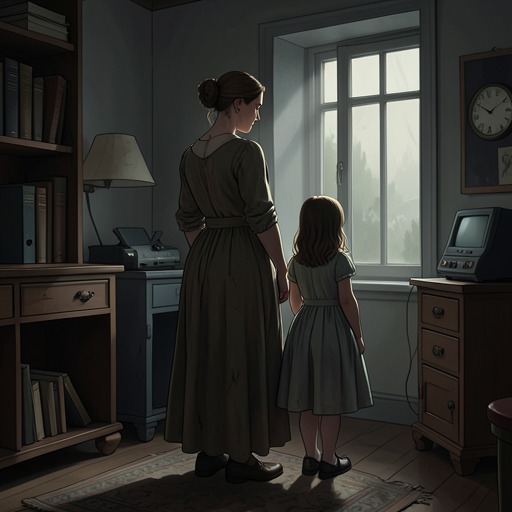
Bathsheba's flight and return to the farm
Far from the Madding CrowdBathsheba's flight and return to the farm mark the immediate aftermath of Sergeant Troy’s rejection of her and the moment she turns from escape to deliberate endurance. After Troy tells her that she is nothing to him and denies that their marriage makes him morally hers, she runs from the house; by morning, she has decided to return, conceal her distress, and remain in the household while Fanny Robin is taken away.
Causes and Immediate Flight
The crisis follows Bathsheba’s discovery of Fanny Robin’s body and Troy’s admission that he had been a bad husband. His declaration that Fanny, even dead, mattered more to him than Bathsheba, followed by his claim that the marriage ceremony did not make him morally hers, transforms the encounter into a direct rejection of their union. Bathsheba gives no answer that could alter his position. A powerful impulse to get away from him and his words takes hold, and she runs out of the house without stopping to plan where she will go.
Her flight begins in darkness, on a road whose direction and destination she neither knows nor cares about. At a gate leading into a thicket, she recognizes that the seemingly impassable growth is actually a brake of fern and goes inside to hide. She finds shelter beneath a leaning tree and draws armfuls of the surrounding fronds and stems around herself. The movement is less a journey toward a new life than an attempt to escape the immediate scene and its words.
The Night in the Wood
Bathsheba is uncertain whether she sleeps. When she becomes aware of the morning, the change in her surroundings brings a pause to the emotional crisis: birds call from the trees and hedge, and a team of her own farm horses stops at a pond before returning toward the farm. These ordinary signs of daybreak place her private flight against the continuing routine of farm life. Red and yellow leaves have settled on her lap and hair; when she shakes them from her dress, leaves around her stir and rise in the breeze. The episode makes the night’s desperate resolve appear different in the light of morning, without erasing what precipitated it.
Liddy Smallbury finds her in the wood. Bathsheba’s voice has been reduced to a whisper after the night outdoors, and she asks Liddy not to question her about what happened. Liddy explains that she searched because Bathsheba was not at home and that she had suspected something was wrong after hearing Troy’s voice. Bathsheba asks whether he is home and whether Fanny has been taken away. On learning that Troy has left but Fanny’s body has not yet been removed, she chooses to stay in the wood for the time being rather than return at once.
Choosing to Return
Liddy brings Bathsheba a cloak and hat, bread and butter, and hot tea in a small china jug. Bathsheba eats and drinks sparingly; her voice grows clearer and some colour returns to her face. She and Liddy then walk in the wood for nearly two hours. Bathsheba’s thoughts remain fixed on whether Fanny has been taken away, and she asks Liddy to find out. Liddy returns with word that the men are just removing the body and that people have asked for Bathsheba, who has been represented as unwell and unable to see them.
Bathsheba now revises her first intention to disappear. She says she has altered her mind and explains her decision in terms of pride, social judgment, and the costs she expects a runaway wife to bear. In her calculation, leaving would make her an encumbrance and a byword as well as a burden to herself; she resolves to stand her ground despite the possibility of insult, mistreatment, or deprivation. Her argument does not make the marriage tolerable or settle what she will do in the long term. It explains why, at this point, she chooses not to leave it by flight. When Liddy asks what has happened between the couple, Bathsheba refuses to tell her.
Return and Withdrawal
Bathsheba and Liddy return to the house by a circuitous route and enter at the rear. Rather than resume her ordinary life in the occupied rooms, Bathsheba goes up the back stairs to a disused attic and makes it her temporary refuge. She appoints Liddy her confidante and asks her to arrange a fire, carpet, bedstead, bedding, table, and other necessities, with Liddy and Maryann to help carry them up. The attic turns a return to the household into a retreat within it: Bathsheba is back at the farm, but separates herself from the rooms and routines below.
Bathsheba considers how to occupy the heavy interval ahead. She rejects sewing, knitting, and finishing her sampler, which she regards as outdated, and asks instead for books from her uncle’s stored collection. Her choices move between tragedy and lighter reading: she names Beaumont and Fletcher’s The Maid’s Tragedy, The Mourning Bride, Night Thoughts, and The Vanity of Human Wishes, then rejects Liddy’s suggestion of another dismal book and requests Love in a Village, Maid of the Mill, Doctor Syntax, and volumes of The Spectator. The exchange gives the retreat a practical shape while showing that Bathsheba does not simply surrender to the bleakest possible view of her future.
For that day, Bathsheba and Liddy live in the attic in a state of barricade. The precaution proves unnecessary as a defense against Troy, who does not come near or trouble them. Bathsheba sits by the window until sunset, attempting to read at times and watching the activity outside at others. Her return therefore does not amount to reconciliation with Troy: she stays at the farm, but withdraws from him and entrusts her immediate care to Liddy.
Significance and Aftermath
The episode turns on a reversal from flight to remaining. Bathsheba first responds to Troy’s repudiation by running without direction; after a night apart, she chooses a more controlled form of resistance, returning on her own terms and occupying a secluded room in the house. Her decision is neither a restoration of the marriage nor a claim that she is safe or content. It is a response to the social and material predicament she perceives in leaving, and it keeps her physically within the household while preserving a private distance from Troy.
That choice takes place within Bathsheba’s wider dependence on the farm. Earlier she had declared to the workers that she would manage it with her own head and hands and had insisted that they should not assume a woman could not distinguish good conduct from bad. Now, after her marriage, the farm remains central to her prospects: she fears losing it, and the estate’s confidence in her position as James Everdene’s successor had depended on the terms of her uncle’s will and her demonstrated command of the livestock. Her retreat to the attic gives her temporary shelter, but does not remove the uncertainty about her marital and economic position.
Bathsheba’s return also contrasts with the confidence of her earlier public self. At the farm meeting, she promised to rise early, work in the fields, and serve the workers if they served her well. In the attic, she cannot yet resume that energetic public role; she relies on Liddy to bring food, clothing, and books, and keeps her distress private. The event thus connects a personal rupture to the vulnerability of a woman whose authority as farm manager and security as a married woman are not the same thing. Her return preserves her place in the household for the moment, but the unresolved marriage continues to shape what she can expect from the future.